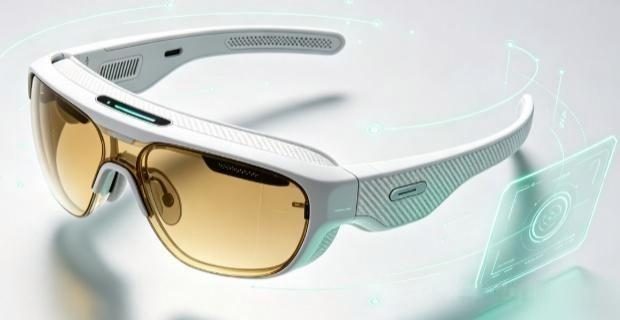
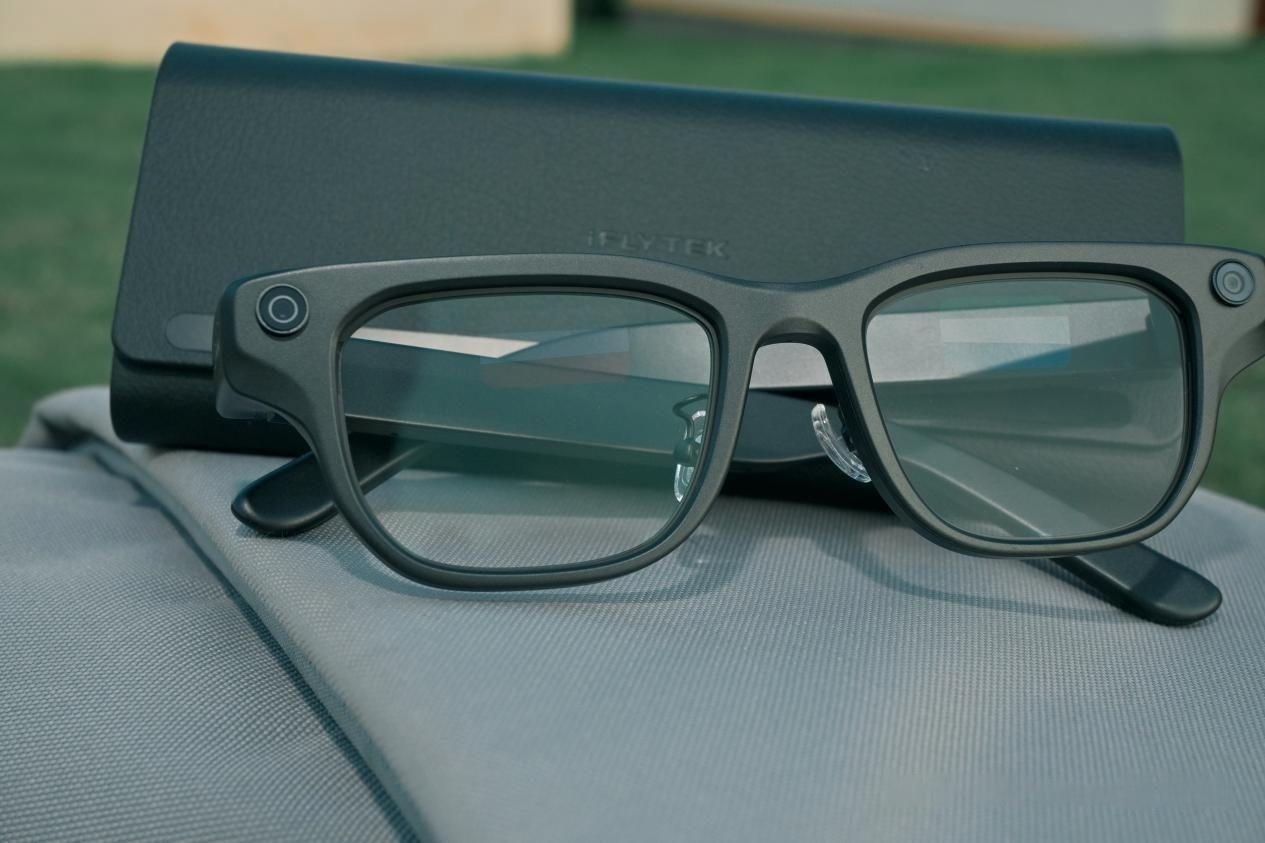
The argument about smart glasses has been settled for longer than the product category has existed: a device worn on the face is judged as eyewear first and as technology second. A pair that adds a camera, a speaker, cellular connectivity and storage to the frame pays for every one of those features in weight and in bulk, and the weight is what stops it being worn on the third day.
The camera-free display class takes the opposite approach. It removes the hardware that is expensive in grams and keeps the parts that are cheap in grams: a small optical engine, a bone conduction microphone and a display that appears in front of the eye. This review covers one of the most fully realised examples of that approach.
Wearable first, intelligent second
The case for this class rests on three conditions that have to hold at the same time. The appearance must not be conspicuous, the frame must stay comfortable over a full day, and the battery must last one. A pair that misses any of the three is a device that gets left at home, and a device left at home has no features at all.
Everything below is a consequence of taking that position seriously. Published weight is 34 g, which is in the range of ordinary metal-framed spectacles. There is no camera, so the question of when the device is recording does not arise. There is no speaker, so audio output is replaced by text. There is no cellular radio and no local media storage.
Frame, materials and construction
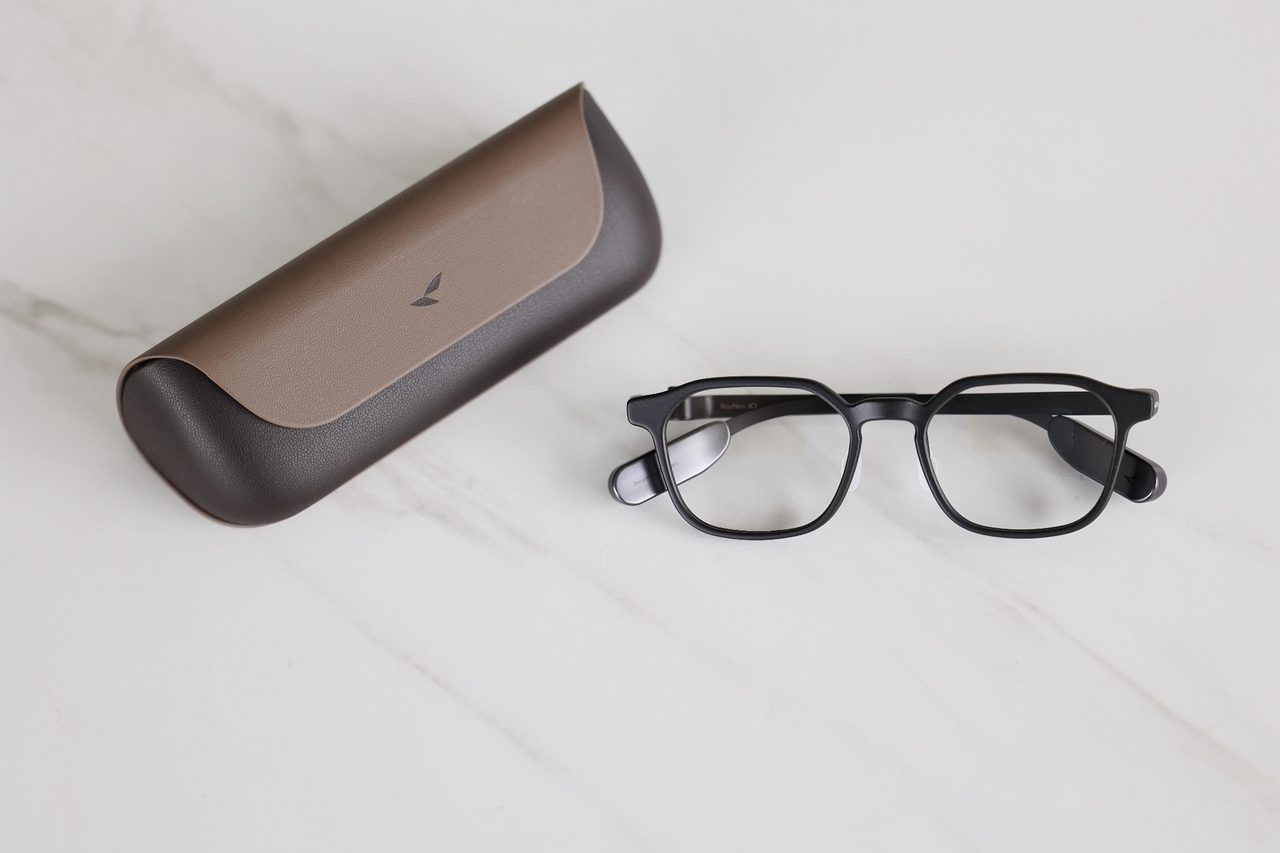
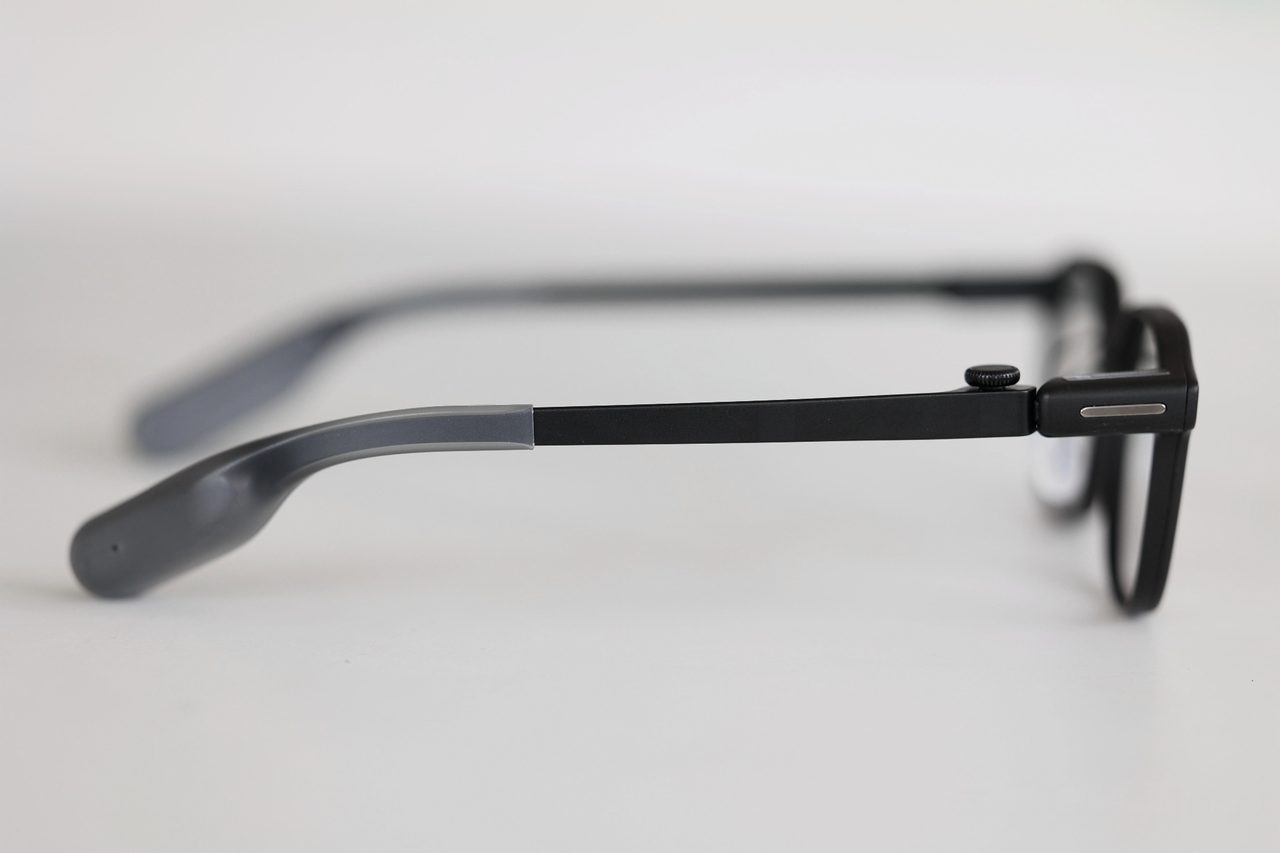
The front frame is magnesium-aluminium alloy, and the temples combine two grades of titanium - a beta-titanium body with a titanium alloy outer cover. The combination is chosen for stiffness at low mass rather than for appearance, and it is the main reason a display pair can be built this light.
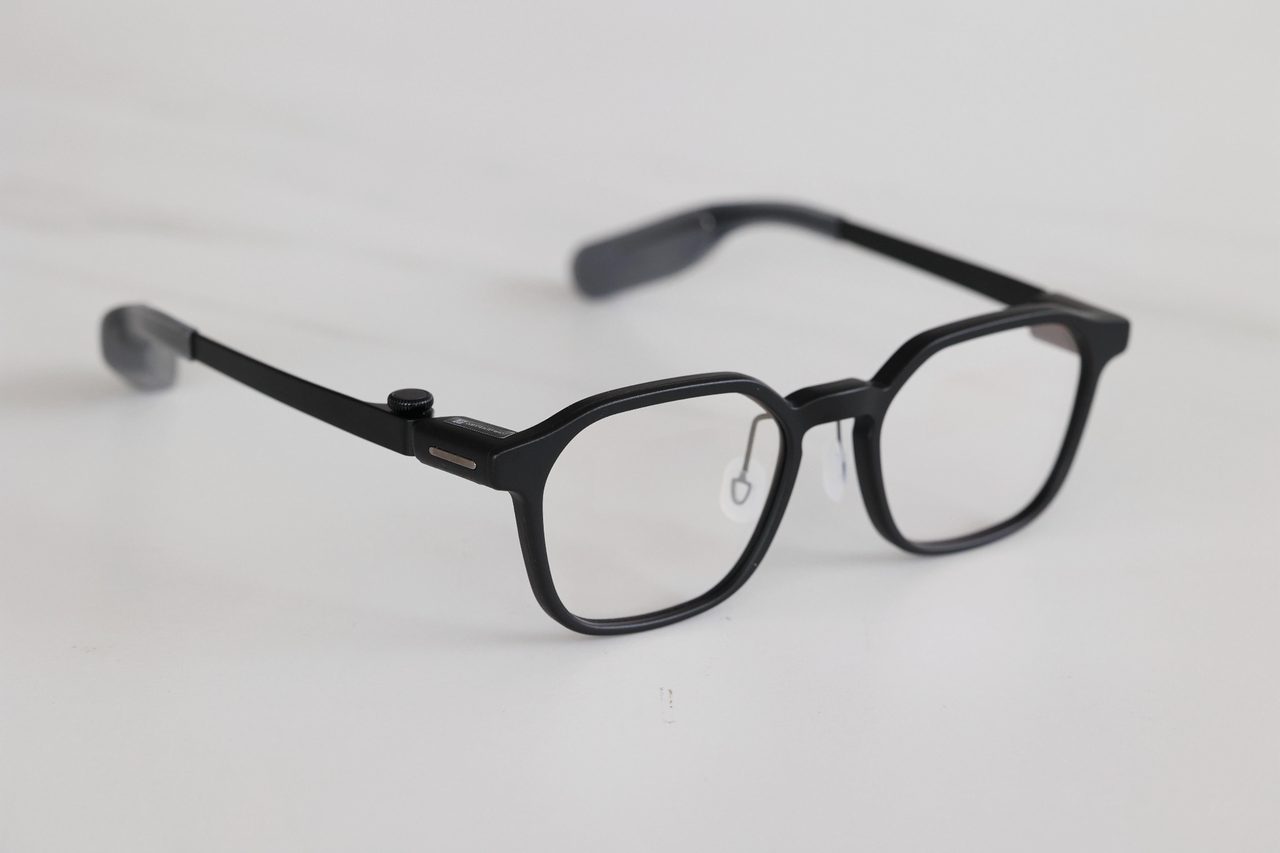
The battery and the main board sit at the far end of the temple rather than in the front of the frame. That placement does two things: it keeps the front frame thin, and it moves the centre of gravity backwards so the frame balances across the nose instead of tipping forward. The rear section of the temple is wider than the front, but it sits behind the ear where it is largely hidden. Removable silicone sleeves are supplied for the temples.
Weight, measured
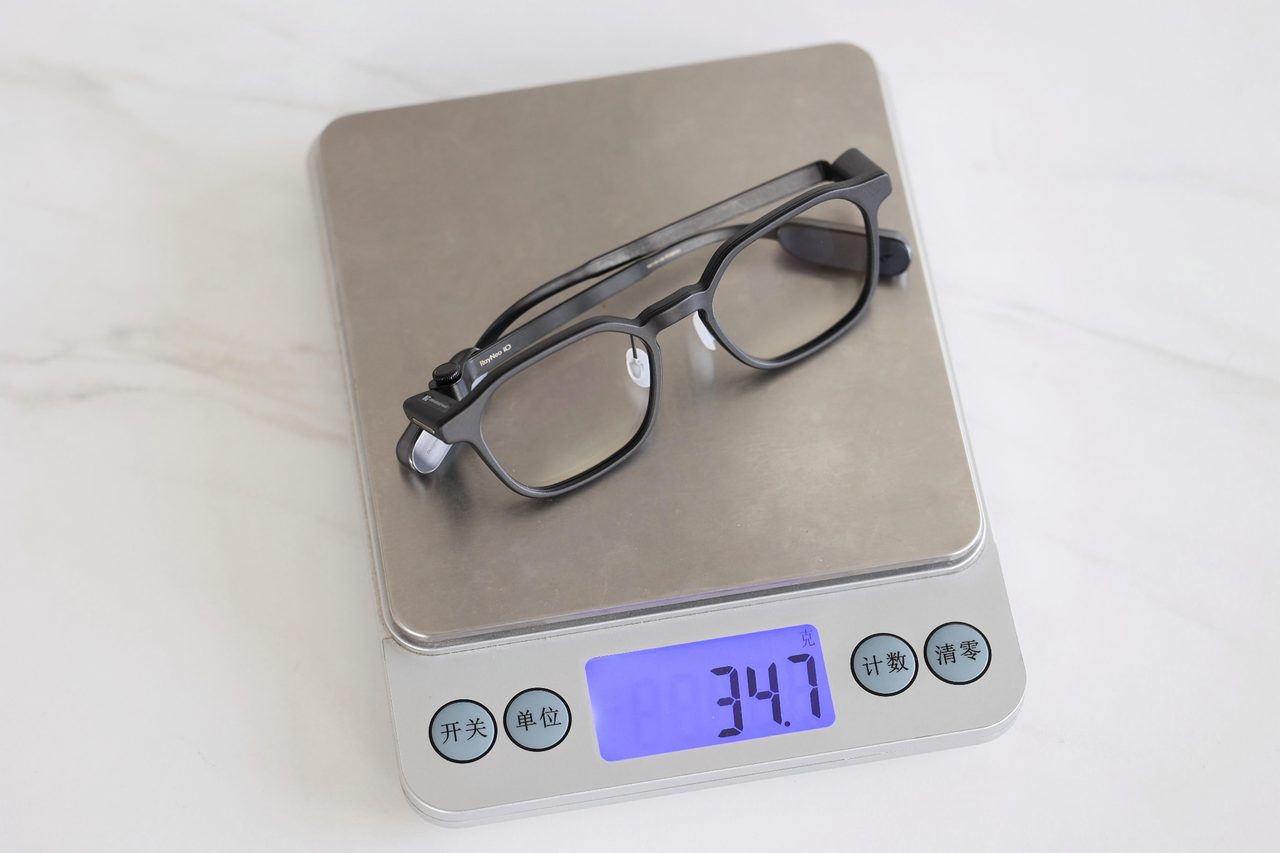
Claimed weight is 34 g. On a kitchen scale the pair measured 34.7 g before the silicone sleeves were fitted and 38.4 g with them, which puts a single sleeve at under 2 g. The difference between the claimed and measured figures is within the tolerance of a domestic scale, and either number supports the same conclusion. This is in the same weight class as ordinary spectacles, rather than in the same class as a camera-equipped pair.
A single control
There is one physical input on the whole device: a knurled wheel at the joint between the right temple and the frame. Rotating it moves between display screens, a short press advances, a long press goes back, and a double press opens the assistant. That is the complete interaction model, and it takes about two minutes to learn. The design choice is deliberate - every additional button on a pair of glasses is something that can be pressed by accident.
Display technology and optics
The display is a full-colour waveguide. The optical path is worth understanding because it explains the cost and the compromises of the class. A micro display generates the image; a light engine converts it into a collimated beam; the beam is expanded inside the waveguide by internal reflection; and the expanded beam exits into the eye. The result is a virtual image that appears to float at a distance in front of the wearer while the real world remains visible behind it.
Manufacturer figures for this model describe a light engine of 0.085 cm3 producing an image with the apparent size of a 33-inch screen, with in-eye brightness quoted at up to 1800 nits and DC dimming throughout the brightness range, and third-party low-blue-light and flicker-free certification. The waveguide itself is quoted below 0.6 mm thick and about 3 g, with transmittance of 93 per cent in the optical grating region against 98 per cent elsewhere in the lens. Colour deviation is quoted at a Delta-E of 2.52, and the lens assembly is stated to meet EN ISO 12312-1, the European standard for everyday spectacle lenses.
The practical consequences are the ones worth checking in person. On a photograph the optical region is close enough to the surrounding lens that the frame does not read as a display device in normal conversation. From certain angles - looking along the lens from the inside against the light - two narrow horizontal bands become visible in the upper middle of each lens. Those bands are the optical elements that expand the image into the eye, and they are the physical evidence that this is not an ordinary pair.
How the same optical approach fares against the other display-equipped frames on the market is the subject of Display AR glasses compared.
The optical arrangement behind that result belongs to a wider class of device, described under head-mounted displays, which is where the weight and field-of-view constraints originate.
Battery, and the two ways to charge it
Capacity is 240 mAh. Two days per charge is claimed under normal use, and 18 hours with the always-on memory function running, which is the more useful figure because it describes the worst case for power draw. Two charging paths are supported: a clip that grips the frame at a single contact point and connects to a cable, or a charging case that tops the pair up the way a case charges wireless earbuds. The case version matters for travel; the clip is small enough that it is easier to leave at home.
Active AI, not just assistant AI
Most assistant implementations in this category wait to be asked. This one also runs continuously in the background, and the two halves are worth separating.
The always-on function records and organises the day's audio, producing a timeline of events with one-line headings that can be reviewed later. It is the feature that sounds least necessary in a description and turns out to be the most used: the record exists whether or not the wearer decided to make it. A double press opens the assistant, which can be queried about the recorded material with a context window quoted in the region of one million tokens. That is long enough that the limiting factor is what the wearer remembers to ask about, rather than what the device remembers.
The assistant is selectable between two current open-weight large models, and answers appear as text on the display rather than as speech. That is a deliberate inversion of the usual microphone-and-speaker pattern. Reading an answer is faster than listening to one, and it is private in a way that a speaker is not. Voice input uses a bone-conduction microphone, which picks up vibration through the skull rather than airborne sound and is therefore far less affected by surrounding noise.
Four air-conduction microphones form an array that uses beamforming to locate a speaker by direction. Live subtitles cover 55 languages and 109 accents through the manufacturer's translation engine. For a wearer in a meeting, a lecture or a conversation in a second language, this is the function that justifies the device. A related benefit is rarely raised in marketing but is one of the most useful: the subtitles can be read by a wearer with hearing loss, converting speech that cannot be heard into text that can be seen.
Three further functions come from the same microphone hardware. A prompt mode watches a conversation for questions and offers reference points, which is useful for interviews and for anyone who finds live questioning difficult. A teleprompter scrolls a script automatically by tracking where the speaker has reached, removing the manual paging of a conventional prompter. And recording transcription separates speakers, allows key moments to be marked during the recording so they can be returned to directly, and produces an exportable transcript with a summary in a choice of templates.
A different answer to the same question is examined in the iFLYTEK AI Glasses review, where the assistant is replaced by interpretation and little else.
Privacy as a precondition
For a device that records continuously, privacy is not a feature to be compared against a competitor's. It is the condition under which the features are acceptable at all. Continuous audio capture, together with access to call, message, calendar and location permissions, means the question is not whether data is processed but how.
The manufacturer describes a four-layer framework covering a privacy baseline, state awareness, user data sovereignty and enterprise compliance, with uploaded logs anonymised irreversibly on the device before transmission, and with all permission activity logged and reviewable. Independent certification is quoted across eight standards, including GDPR, the EU Cyber Resilience Act, CE marking and ISO 27001 and ISO 27701 for information security and privacy management. A white-hat security team is stated to have run penetration testing against the system from an external position. The certifications are the part that can be verified; the framework itself can only be described, which is true of every product in this category.
The competing position on capture and consent, from the largest platform in the category, is described in the coverage of the Meta Glasses launch.
Who this suits
- Buyers who want information in front of the eye and no camera on the frame.
- Anyone in meetings, lectures or second-language conversations who needs a record rather than a recording.
- Wearers with hearing loss, for whom live subtitles change what a conversation costs.
- Buyers who find an ordinary pair of glasses comfortable and want nothing heavier.
Verdict
This is a coherent answer to a question the category has mostly answered badly. By removing the camera and the speaker it reaches a weight that makes daily wear realistic, and it spends the savings on a display and on software that runs without being asked. Buyers who want to take photographs should look elsewhere, and buyers who want audio playback should look elsewhere; there is no version of this device that does those things.
What it does instead is make a specific set of tasks - reading a subtitle, following a prompt, keeping a record of a day - available without a screen in the hand. Launch pricing was listed at ¥1,996 on the home market, roughly US$280 at the time of writing, which places it in the middle of the display class rather than at the top of it. Local pricing and availability vary by market, and prescription lenses are ordered separately, so the fitting parameters need to be supplied at the point of purchase rather than afterwards.