A power bank is sold on one number and judged on another. The number on the box is rated capacity in milliamp-hours; the number that matters is the watt-hours the bank can actually deliver to a device. Almost every poor purchase in this category comes from reading the first figure as though it were the second.
Rated capacity is not delivered energy
Cells inside a power bank are nominally rated at 3.6V to 3.85V, while the output is delivered at 5V, 9V, 12V, 15V or 20V. Converting up involves losses, and so does the boost converter, the protection circuitry and the cable. The result is that a well-designed bank delivers roughly 60 to 70 percent of its rated energy to the device; a poor one delivers noticeably less. A bank marketed at 20,000mAh is therefore closer to 12,000 to 14,000mAh of usable output, and the honest way to compare two banks is by the watt-hours they deliver, not by the milliamp-hours printed on the label.
The watt-hour limit that decides whether it can fly
Lithium batteries travel under a watt-hour limit rather than a milliamp-hour limit, and cabin rules are stricter than checked-baggage rules. The thresholds that apply almost everywhere are these: up to 100Wh may be carried without approval, typically in hand baggage only; between 100Wh and 160Wh requires the airline's prior approval and a limit on how many units a passenger may carry; above 160Wh lithium batteries are not permitted in passenger baggage at all. Conversion is direct - watt-hours equal milliamp-hours multiplied by nominal voltage and divided by 1000 - so a 20,000mAh bank at 3.7V is 74Wh and travels freely, while a 30,000mAh bank at 3.7V is 111Wh and needs approval. Power banks belong in the cabin in every case, never in a checked bag, because a battery that fails in an inaccessible hold cannot be dealt with.
Output: what the bank can give, and to what
Output capability divides into two questions. The first is the highest single-port wattage, which determines whether the bank can charge a laptop rather than merely maintain one: 45W will charge a thin-and-light slowly while in use, 65W will hold it, and 100W or more will charge it at close to wall speed. The second is what happens when two or three devices are connected at once, because the total output is shared and the split is rarely additive.
USB-C Power Delivery is the protocol that matters, and PPS support is what several Android vendors require for their fastest phone charging rates. A bank without PPS will still charge those phones, just at a lower rate. Vendor-specific fast modes should be read the same way as on a wall charger: they apply to that vendor's devices and to nothing else.
Recharging the bank is the specification people ignore
Input wattage determines how long the bank itself takes to refill, and it varies more than the output does. A 20,000mAh bank refilled at 18W takes most of a night. The same bank refilled at 45W takes roughly two and a half hours, and at 100W just over an hour. For anyone who treats a power bank as a daily carry rather than an emergency item, input wattage is the difference between a device that is always ready and one that is perpetually half empty, and it is worth more than a few thousand milliamp-hours of extra capacity.
Pass-through charging, and what it costs
Pass-through charging lets a bank charge itself and a connected device at the same time. It is genuinely useful at a single wall outlet in an airport or a hotel room with one usable socket. Two caveats apply. Efficiency is lower than either function alone, because the bank is converting in both directions and the losses compound. And not every bank implements pass-through in a way that protects the cells; where a manufacturer documents it, the documented behaviour is the one to trust.
Cells, cycle life and heat
Two cell chemistries dominate. Lithium-polymer packs are lighter and can be shaped to fit thin housings. Lithium-ion cylindrical cells - typically 18650 or 21700 - are heavier and bulkier for the same capacity but generally tolerate heat and cycle count better. Cycle life, the number of full charge and discharge cycles before capacity falls to about 80 percent, ranges from roughly 300 cycles on budget packs to 500 to 1000 on better ones. Heat is the main thing that shortens it, which is why a bank run hard while charging a laptop in direct sun will age faster than one used the same number of times at room temperature.
Wireless and magnetic attachment
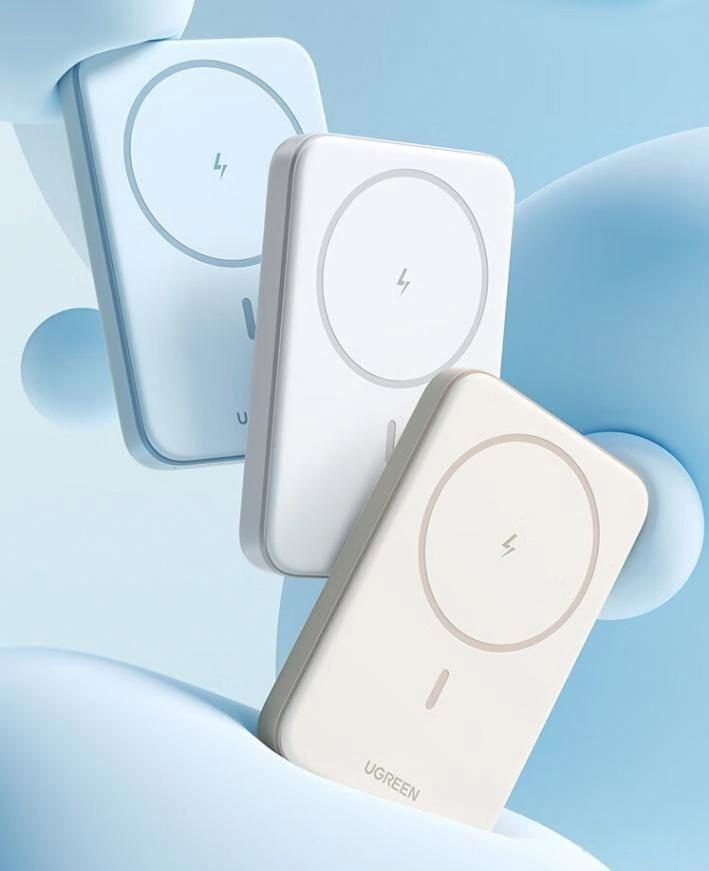
Magnetic banks that snap to the back of a phone trade capacity and efficiency for convenience. The magnetic coupling typically delivers 7.5W to 15W, which is far below wired output, and the alignment coil adds thickness. The trade is reasonable for a phone used while walking and poor for anything that needs to charge quickly or for a laptop. Where a magnetic bank also offers a wired port, the wired port is almost always the faster path.
What is worth paying for
In rough order of value: honest capacity reporting, meaning watt-hours as well as milliamp-hours; an input rating high enough to refill the bank overnight; USB-C PD on every port, so that the ports are interchangeable; protection circuitry that is described rather than implied, covering over-current, over-voltage, over-temperature and short circuit; and a recognisable safety certification, since a power bank is a dense energy store carried against the body. Display brightness, colour options and the number of ports beyond three are the features that cost money without changing whether the bank does its job.