Multi-port chargers have become the default recommendation for anyone with more than two devices, but the category has a structural problem that specification sheets tend to hide. Sustained high-wattage output, safe low-temperature operation and a compact body are difficult to achieve at the same time. Most products deliver two of the three.
The failure modes are familiar. A high-wattage unit turns out to be brick-sized and consumes most of a bag. A compact unit cannot sustain enough power for a laptop and takes hours to fill it. A compromise model runs hot under sustained load and triggers thermal derating, so the advertised wattage is available only in short bursts.
How this comparison was carried out
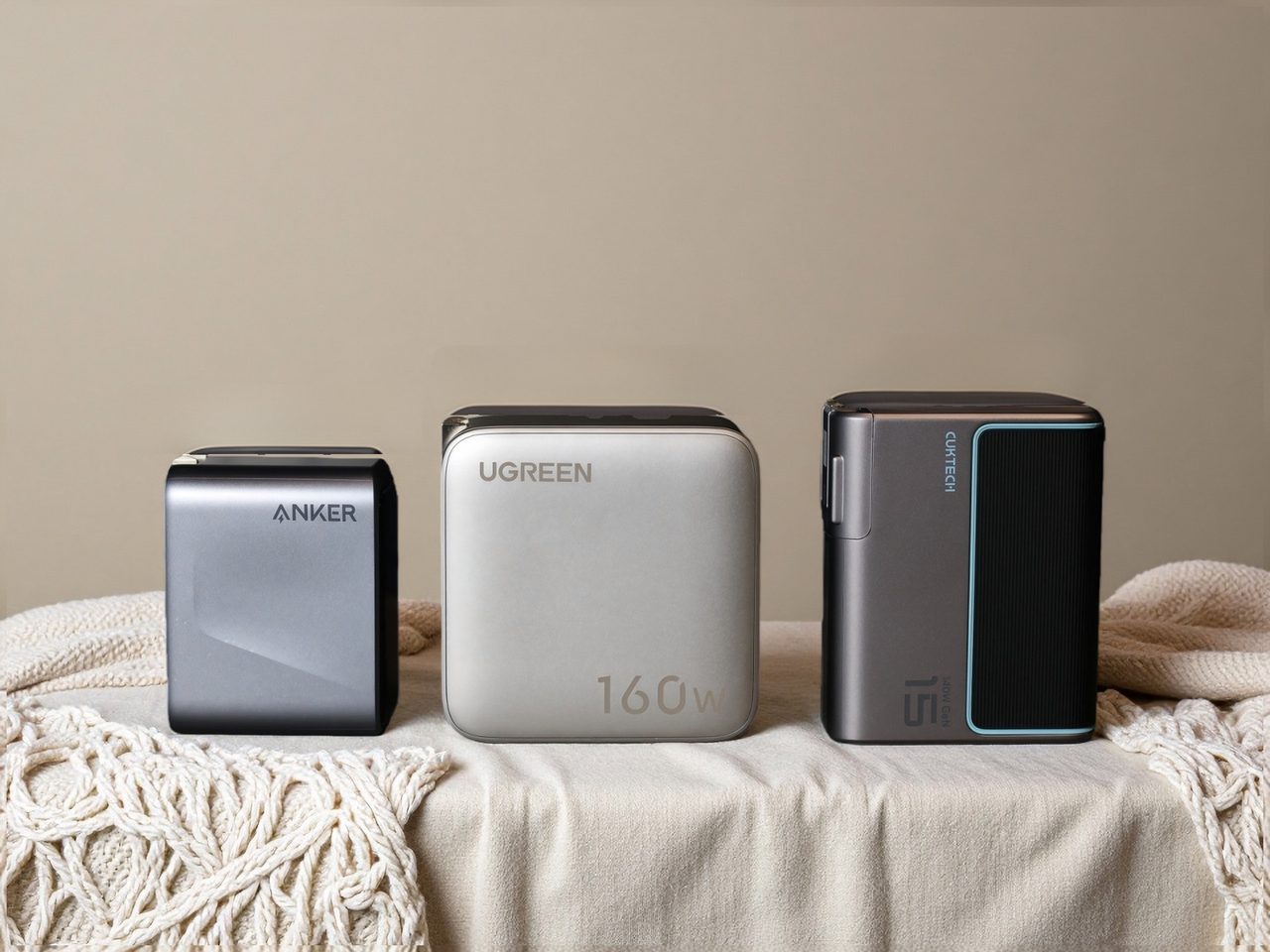
The three chargers below were compared in a single controlled test round on the same bench, using the same cables and the same set of devices. Weight was measured on a scale in grams, and volume was derived from physical dimensions and expressed in cubic centimetres. Sustained output was monitored over a two-hour period with a single port loaded. Multi-port behaviour was observed by adding devices sequentially and recording the allocation each time. Figures from that round are reported as measured values, and manufacturer claims are identified as such. Results describe one sample of each product and should be read alongside the wider review record rather than as a permanent verdict.
The three contenders at a glance
| Metric | Anker Prime 160W | UGREEN 160W | CUKTECH 15 140W |
|---|---|---|---|
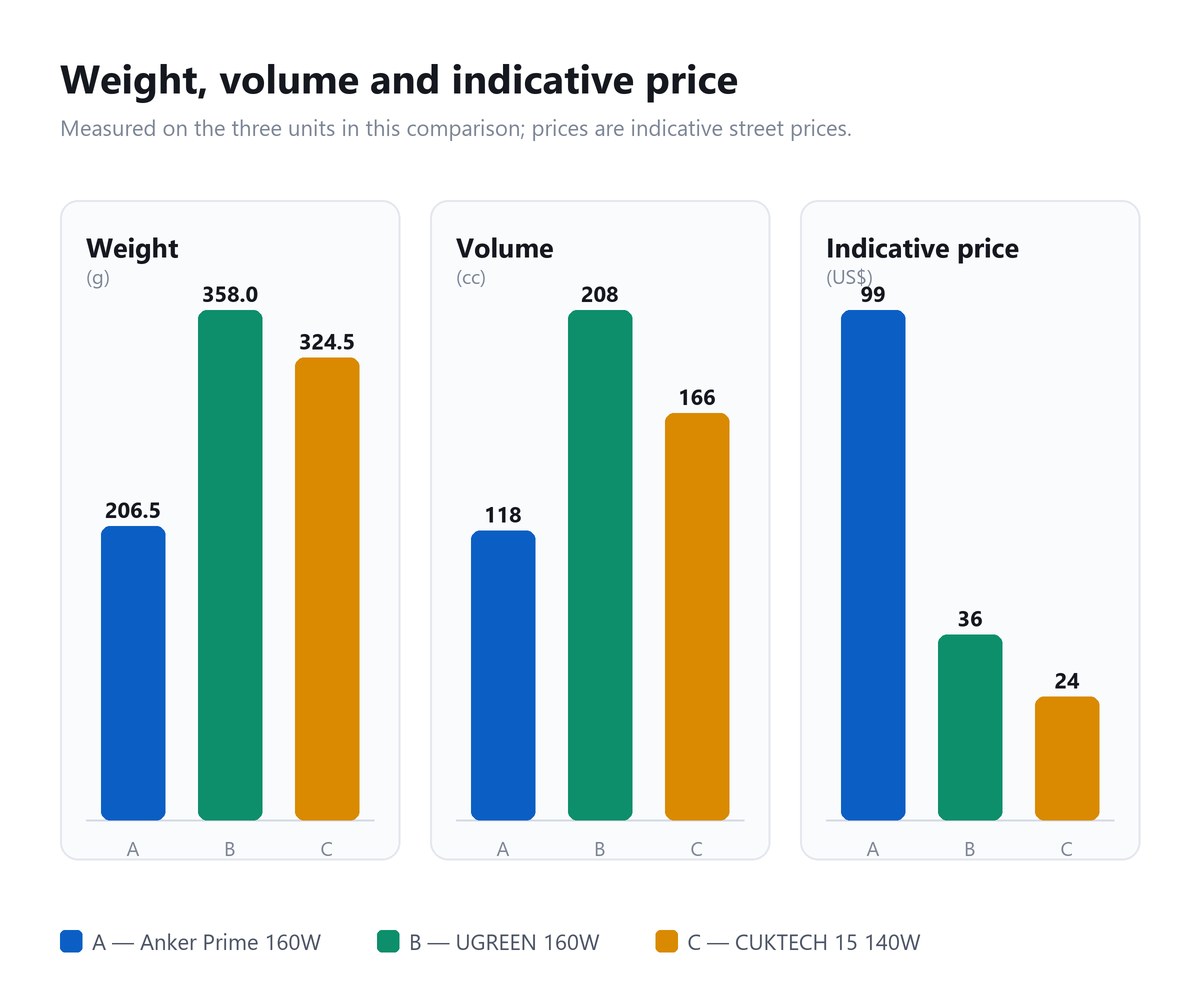
| Measured weight | 206.5 g | 358 g | 324.5 g |
| Measured volume | 118 cc | 208 cc | 166 cc |
| Ports | 3 × USB-C (no USB-A) | 4 × USB-C + 1 × USB-A | 3 × USB-C + 1 × USB-A |
| Maximum single-port output | 140W on any port | 140W on C1/C2; C3/C4 30W; A 22.5W | 140W on C1/C2; C3/A 33W |
| Output strategy | Dynamic, per-port allocation | Fixed preset splits | Fixed preset splits |
| Display | Yes, orientation aware | Yes, shows voltage, current and protocol | None |
| App control | Yes | No | No |
| Indicative price | ¥699 (about US$99) | ¥259 (about US$36) | ¥169 (about US$24) |
Portability: weight and volume
- Anker Prime 160W: 206.5 g, the lightest of the three by a clear margin.
- UGREEN 160W: 358 g, roughly 1.73 times the Anker.
- CUKTECH 15 140W: 324.5 g, roughly 1.57 times the Anker.
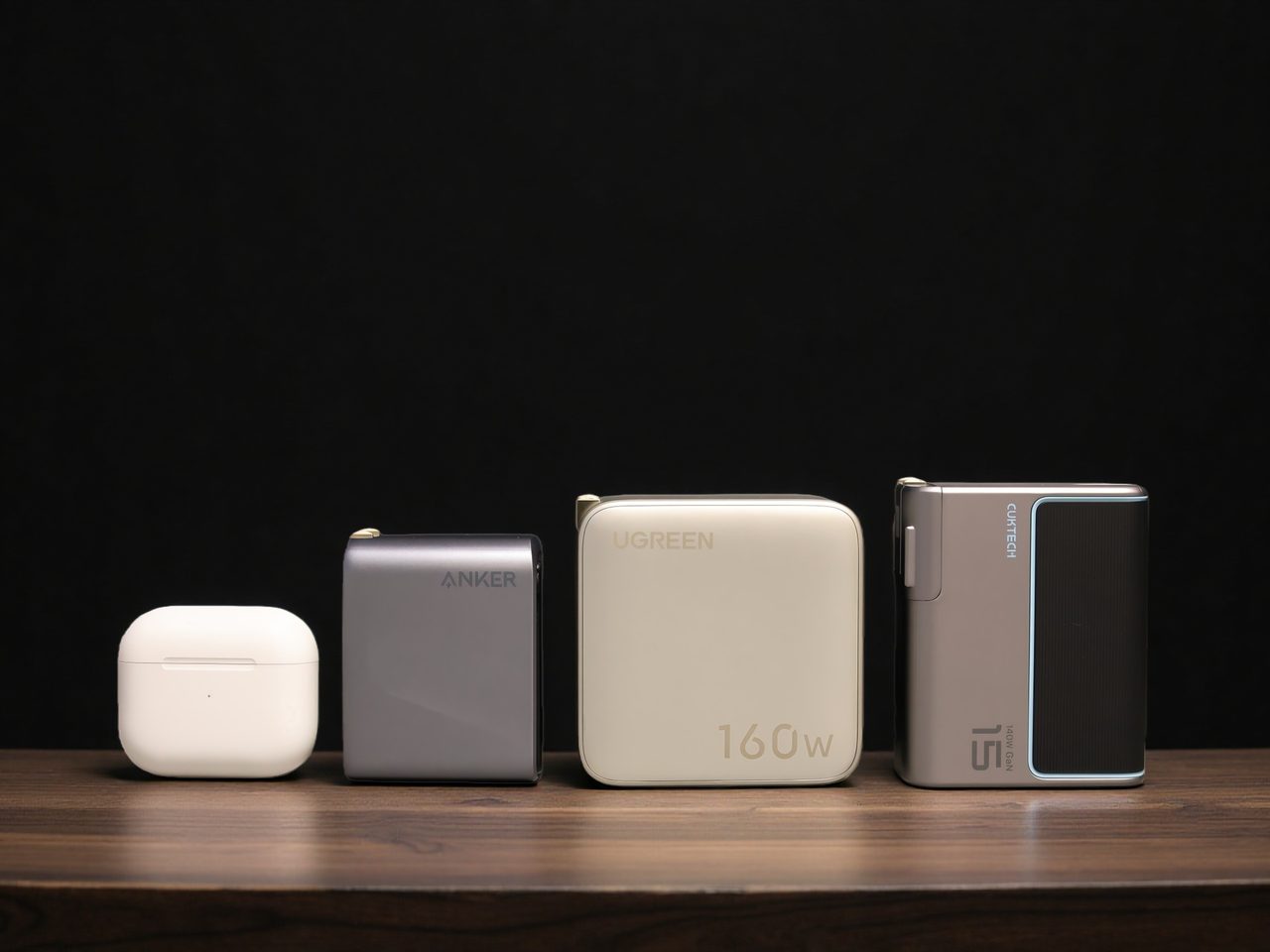
Measured volume follows a similar pattern: 118 cc for the Anker, 208 cc for the UGREEN and 166 cc for the CUKTECH. Set against an earbud charging case, which is a familiar pocket-size reference, all three are compact for their output, but the difference between the smallest and the largest is substantial in a bag.
The Anker's combination of high output and small volume comes from a multi-level DC-DC architecture and a high degree of component integration, an approach normally found in larger power systems rather than consumer electronics. Finer voltage control reduces conversion losses and lifts peak efficiency. Higher efficiency means less energy leaving as heat, which is what makes a small body possible at 140W. The architectural change also allows nine PCBs to be stacked precisely, with miniature magnetic components and small step-down inductors, so that a housing comparable to an earbud case can sustain 140W from a single port without derating. The manufacturer states that the architecture supports 24 hours at full load; the independent two-hour observation below is consistent with a steady 140W.
Port configuration. The UGREEN offers the most ports at five (4C1A), so it can accept more devices simultaneously, though each receives a smaller share and overall charging efficiency per device suffers. The CUKTECH offers four (3C1A), a balanced and practical configuration. The Anker provides three USB-C ports and no USB-A.
Both the UGREEN and the CUKTECH accommodate legacy USB-A accessories, which the Anker cannot. That is a genuine inconvenience, offset by the reduction in size and by the direction the market is moving: USB-C is becoming the default. For a charger that stays on a desk and never travels, the extra ports on the other two are more attractive than the Anker's compactness.
All three have foldable pins. The Anker's body is flat and its pins sit flush, so it packs cleanly without digging into anything adjacent. The UGREEN's more pronounced rounded edges leave its pins slightly exposed, which marginally affects how it feels when packed. The CUKTECH resembles the Anker in pin design, though a small protrusion near the lower section also affects packing comfort slightly.
Output strategy and sustained power
All three can approach their rated total output when several ports are loaded, although the CUKTECH's multi-port ceiling is closer to 130W, and real-world results depend on the protocols each attached device negotiates.
Dynamic allocation versus fixed presets
The Anker uses a fifth-generation intelligent allocation system that identifies each attached device and its charging protocol in real time, then adjusts output accordingly. Two devices charging at high speed simultaneously are allocated power dynamically, and because every USB-C port can deliver up to 140W, there is no need to remember which port supports which rate. That last point matters more than it sounds: with the other two, charging a laptop requires recalling that only C1 and C2 carry full power, and multi-port behaviour requires a separate mental table.
The UGREEN and the CUKTECH use fixed preset allocations. With two ports in use, the UGREEN concentrates on a 100W + 60W split, which is very stable and holds the connection through plug and unplug events, but is less flexible. The CUKTECH behaves similarly, with a lower ceiling.
Sustained single-port output
All three were monitored for two hours with a single port loaded. The Anker held approximately 140W throughout. The UGREEN was also stable, with occasional small dips. The CUKTECH was weaker at the top end: after roughly half an hour at 140W it derated to about 100W under thermal protection.
140W requires USB PD 3.1 on the receiving device
A single port only reaches 140W if the device being charged supports USB PD 3.1. Examples include current 16-inch laptops, some mini PCs and high-performance gaming notebooks. A device that does not support PD 3.1 will not draw 140W regardless of the charger's rating.
Thermal behaviour
All three implement thermal management, but the sustained-load results differ. The Anker combines its high-efficiency architecture with an active bridge rectifier, a jointly developed high-frequency architecture and an intelligent temperature control layer, so it sustains 140W for two hours with only mild housing warmth. The UGREEN, helped by its larger body and therefore greater thermal mass, also sustains two hours with light warmth. The CUKTECH relies on a simpler GaN thermal optimisation and derates after roughly half an hour at full output.
The device-level reasons a 140W design behaves differently from a 65W one are set out in Inside a GaN charger.
Displays and app control
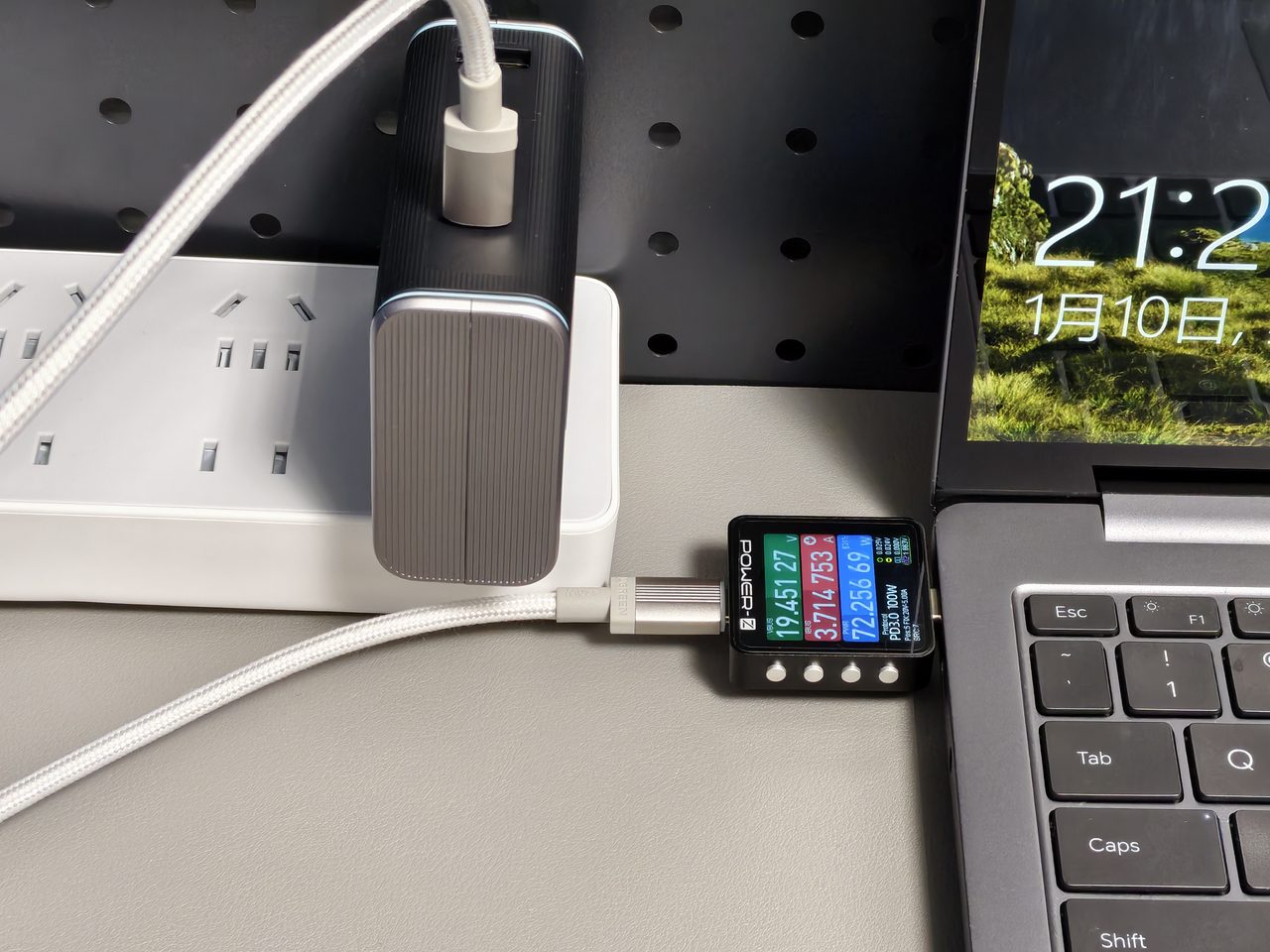
The CUKTECH has no display. Of the other two, both report total and per-port power, and both switch displayed content when a small circle below the screen is tapped.
The Anker's display is clear and well laid out. It shows total and per-port power, and for temperature it indicates the current reading relative to international limits, applying a cut-off if the limit is passed. Charging mode is also shown: an intelligent automatic mode and a C1-priority mode by default, with custom per-port settings available through the companion app. It does not display the negotiated protocol, which matters to a minority of technical users and not to most. A built-in gyroscope lets the display reorient automatically, and cable power rating is recognised and reported when a cable is connected.
The UGREEN's display is comparable in clarity and adds a useful detail: it reports voltage, current and the specific protocol negotiated on C1 and C2, which gives a more complete picture of the fast-charging state. It does not support charging-mode selection or app control, so custom per-port power is not available.
Only the Anker supports app control, over Bluetooth, and the range of settings is broad: screen brightness, screen-off timer, rotation, interface language, plus per-port power limits down to roughly one watt, three charging modes and cable information. The ability to disable individual protocols on a port is the most consequential feature. On a phone whose fast charging suffers from protocol interference, disabling the competing protocols on C1 can measurably improve the negotiated rate. A port set to 80W with two protocols disabled was confirmed to negotiate an 80W fixed PD profile, rather than the 140W PD 3.1 profile it would otherwise offer.
Fast-charging compatibility
- Anker Prime 160W: all three USB-C ports support PD 3.1 at 140W. In testing a 16-inch laptop held 130–140W, and a thin-and-light laptop held 55–75W. Apple devices negotiate their preferred protocol without intervention. A low-current mode covers earbuds and smart watches safely, and dynamic allocation avoids the situation where one device starves the others when three are connected.
- UGREEN 160W: C1 and C2 support PD 3.1 at 140W, C3 and C4 support 30W and the USB-A port supports 22.5W. The screen reports the negotiated protocol, which helps confirm that a device is charging at full rate.
- CUKTECH 15 140W: C1 and C2 support 140W with blind plugging on either port, C3 and USB-A cap at 33W. PD 3.1, PPS, QC and UFCS are supported, with good behaviour on Xiaomi and Apple devices. Fixed allocation keeps simultaneous charging predictable.
Which to choose
| Profile | Best fit | Reason |
|---|---|---|
| Frequent travel, laptop plus phone plus tablet, wants the smallest possible unit | Anker Prime 160W | 206.5 g / 118 cc, 140W on any port, dynamic allocation, sustained output without derating, app control |
| Fixed desk, numerous devices including older USB-A accessories | UGREEN 160W | Five ports, protocol reporting on screen, stable fixed allocation, lower price |
| Tight budget, basic multi-device charging | CUKTECH 15 140W | Lowest price of the three, four ports, adequate sustained performance for mixed loads |
The direction of the category is clear. Competition has moved from raw wattage and port count toward a balance of portability and day-to-day usability. Port count and price remain important, and the two lower-cost options here are reasonable at what they do. The practical difference at the top of the market, however, is now sustained output at small size, together with the tooling that lets a user control how that output is divided.
Continue reading
One Charger for Everything: Why a 65W GaN Unit Replaces Three Power Adapters
Three separate adapters for a laptop, phone and earbuds is a packing problem before it is a charging problem. A 65W three-port GaN unit solves it.
UGREEN 65W GaN Fast Charger Review: Design, Ports and Real-World Speed
Two USB-C ports, one USB-A port, a bundled 1.5 m cable and foldable pins. A close look at what the 65W GaN form factor delivers day to day.
Portability vs. Performance: How to Choose Between Popular GaN Chargers
There is no best charger, only the best fit. Match three everyday usage patterns to the right wattage, port count and footprint before comparing models.